Leo Clarke's story occupies a unique and almost mythic place in Canada's First World War memory, not only for the astonishing audacity of his Victoria Cross action but for the brevity and intensity of his life at war. In little more than two years, Clarke passed from civilian obscurity to battlefield legend, before being cut down almost immediately after his greatest triumph. His career encapsulates both the heroic ideal and the brutal indifference of industrial warfare, where courage could win a battle in one moment and mean nothing the next.

Terry Bailey explains.

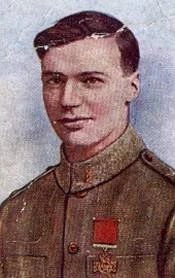
Leo Clarke - colorized. Available here.

Born on the 1st December 1892 in the small community of Waterdown, Ontario, Leo Clarke grew up far removed from the violence that would define his fate. Like many young Canadians of his generation, he was raised in a society still closely tied to Britain, imbued with a sense of imperial duty and adventure. In his early adulthood, Clarke moved west, settling in Edmonton, Alberta, where he worked as a clerk. There is little to suggest that he was extraordinary in a conventional sense; he was not a career soldier, nor a product of military academies. Yet, like thousands of others, the outbreak of the First World War in August 1914 transformed his life almost overnight.

Clarke enlisted in the Canadian Expeditionary Force in 1915, joining the 2nd Battalion of the Canadian Infantry. By the time he reached the Western Front, the romantic notions of war had long since been obliterated by the realities of trench fighting. Mud, shellfire, and relentless casualties defined daily existence. Clarke quickly distinguished himself through aggressiveness and calm under fire, qualities that led to his promotion from the ranks to commissioned officer. By 1916, he held the rank of lieutenant, commanding men in one of the hardest-fought sectors of the front.

The summer and autumn of 1916 marked one of the bloodiest periods in Canadian military history. The Battle of the Somme, launched in July, had already claimed hundreds of thousands of casualties by the time Canadian units became deeply involved near Pozières and Courcelette. The battlefield was a shattered moonscape of shell holes, splintered trees, and pulverized trenches. Gains were measured in yards, often purchased at appalling cost. It was within this environment of attrition and exhaustion that Clarke performed the act for which he would be immortalized.

On the 9th of September 1916, near Pozières, Canadian troops were attempting to consolidate newly won ground when they were held up by a strongly defended German trench. The position posed a serious threat to the Canadian line, and delay meant exposure to counterattack. Rather than wait for orders or reinforcements, Clarke acted on his own initiative. Armed only with a revolver and a supply of grenades, he climbed out of his trench and leapt onto the parapet of the German position, fully exposed to enemy fire.

What followed was an act of battlefield shock that bordered on the unbelievable. From his exposed position, Clarke hurled grenades down into the trench while firing his revolver at point-blank range. His sudden appearance and ferocity produced the illusion that a major assault was underway. German soldiers, stunned by the violence and speed of the attack, broke under the pressure. Clarke moved along the parapet alone, continuing his assault with relentless momentum, killing enemy soldiers and forcing others to surrender as he advanced.

The official Victoria Cross citation later recorded that Clarke killed nineteen German soldiers and captured thirty-three more, all without assistance. Just as crucially, his action neutralized a dangerous enemy position at a decisive moment, allowing Canadian forces to advance and secure the line with far fewer casualties than might otherwise have been expected. It was a moment where individual initiative directly altered the tactical situation, a rare but celebrated phenomenon in the mechanized slaughter of the Somme.

The award of the Victoria Cross recognized not only Clarke's courage but the extraordinary independence of his action. At a time when battlefield success increasingly depended on artillery barrages and coordinated infantry advances, Clarke's lone assault seemed almost an anachronism, recalling earlier ideals of personal gallantry. Yet it was precisely this unpredictability that made his action effective. In a war of routine and repetition, shock and audacity could still break the deadlock, if only briefly.

Clarke's Victoria Cross was gazetted later in 1916, and his deed was widely reported in Canadian newspapers. He became a symbol of Canadian bravery at the front, proof that the young Dominion was producing soldiers equal to any in the British Empire. But the attention and honor came too late to alter his fate. The Somme continued to consume lives indiscriminately, and Clarke remained with his battalion in the line. On the 19th of October 1916, scarcely six weeks after his legendary assault, Clarke was killed in action near Desire Trench during ongoing operations on the Somme. While leading his men under heavy fire, he was struck by a sniper's bullet and died almost instantly. He was just twenty-three years old. There was no dramatic final stand, no heroic flourish to match his Victoria Cross action—only the abrupt, unceremonious end that claimed so many young officers of the Great War.

Clarke's death underscores the cruel paradox at the heart of First World War heroism. Acts of extraordinary bravery could win medals and momentary advantage, but they offered no immunity from the random violence of the battlefield. His life and death illustrate how thin the margin was between legend and loss, and how fleeting individual triumph could be amid the vast machinery of modern war. Today, Leo Clarke is remembered as one of Canada's youngest Victoria Cross recipients and as a figure emblematic of the nation's emergence on the world stage through sacrifice and courage. His grave lies far from home, but his story endures in regimental histories, memorials, and the broader narrative of Canada's First World War experience. In the shattered trenches of the Somme, for a few astonishing minutes, one man standing alone on a parapet changed the course of a fight—and in doing so, secured his place in history, even as history swiftly claimed his life.

Leo Clarke's legacy endures not because his life was long or his career carefully cultivated, but because it distilled, with uncommon clarity, the contradictions of the First World War and of heroism itself. His Victoria Cross action stands as one of the most startling examples of individual initiative in a conflict otherwise dominated by massed firepower and grinding attrition. For a brief moment on the Somme, courage, speed, and audacity triumphed over the machinery of war, reminding contemporaries and later generations that human agency still mattered, even in the most dehumanizing of battles.

Yet Clarke's story resists easy romanticization. The same war that elevated him to national prominence extinguished his life without ceremony only weeks later. His death strips away any lingering illusion that gallantry could shield a soldier from the randomness of industrial warfare. In this sense, Clarke is not merely a heroic outlier but a representative figure, embodying the fate of a generation of young men whose lives were compressed into a handful of violent years and often ended just as abruptly.

For Canada, Leo Clarke's service and sacrifice occupy a significant place in the broader narrative of national maturity forged through war. His actions reinforced the reputation of the Canadian Corps as a formidable fighting force and contributed to a growing sense of distinct national identity within the British Empire. At the same time, his youth and obscurity before the war underscore how profoundly the conflict reshaped ordinary lives, transforming clerks and laborers into symbols of courage at unimaginable cost.

Ultimately, Clarke's story endures because it captures both the extraordinary and the tragically ordinary elements of the Great War. His lone assault on a German trench remains a testament to the power of individual resolve, while his swift death serves as a sober reminder of the war's indifference to such resolve. Remembering Leo Clarke is therefore not only an act of honoring bravery, but also of acknowledging the human price of a conflict that defined a generation. In that balance between heroism and loss, his place in history remains secure, not as a figure of myth alone, but as a young man whose courage briefly altered events and whose fate reflected the unforgiving reality of his time.


The site has been offering a wide variety of high-quality, free history content since 2012. If you’d like to say ‘thank you’ and help us with site running costs, please consider donating here.

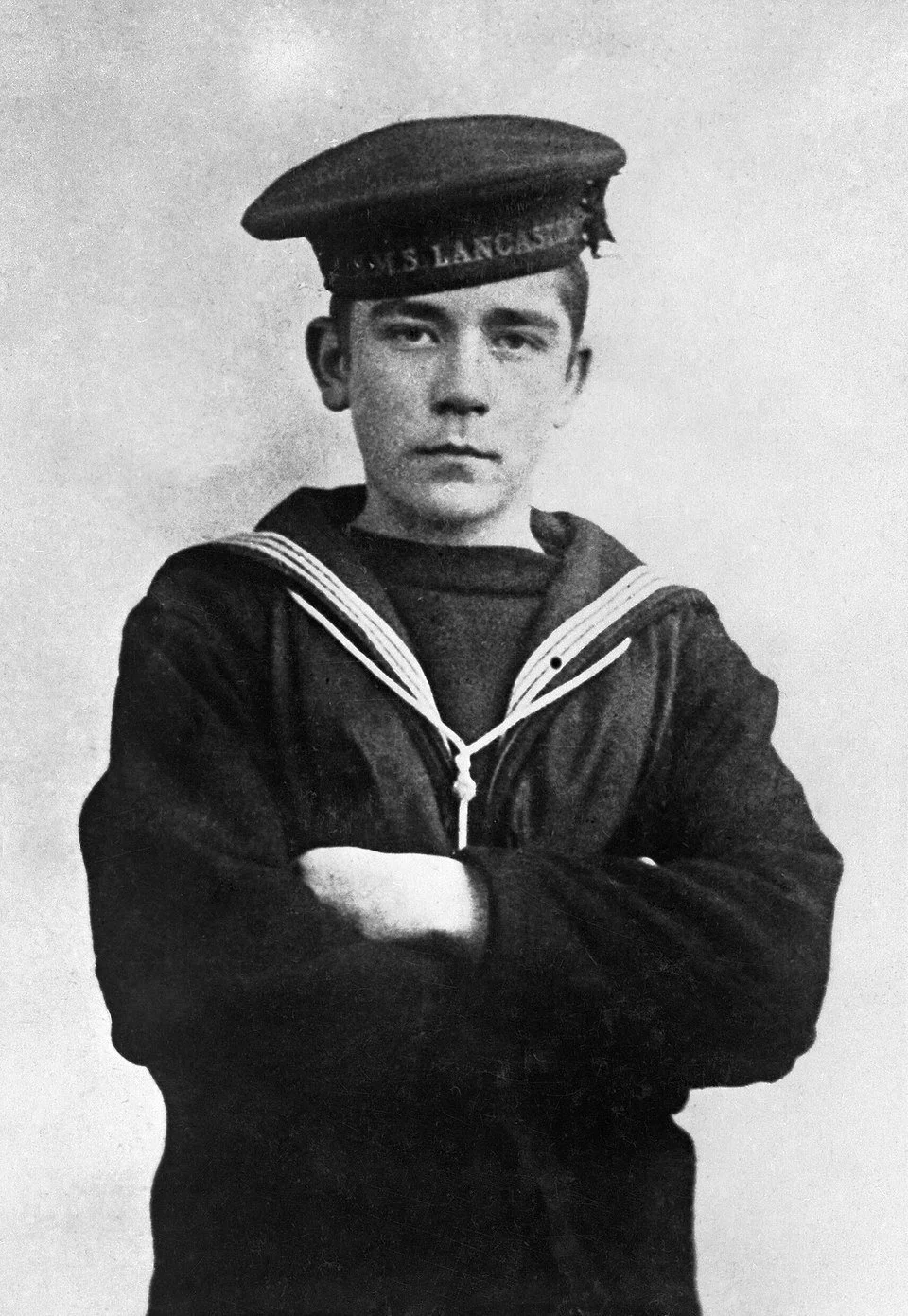
Jack Cornwell was born on the 8th of January, 1900 in Leyton, then part of Essex, into a working-class family for whom life offered few comforts and little security. He grew up in modest surroundings and attended local schools, where he was remembered as a quiet, unassuming boy rather than an exceptional student or natural adventurer. Like many boys of his generation, Cornwell was drawn to the Royal Navy by a mixture of patriotism, the promise of steady pay, and the romance of the sea. At just fifteen years old he enlisted as a Boy Seaman in 1915, undergoing training at HMS Impregnable before being posted to active service at an age when most of his contemporaries were still in school.

Terry Bailey explains.

The image of Jack Cornwell as used by the press at the time of his death. It is now thought to show a younger brother.

In early 1916 Cornwell was assigned to HMS Chester, a newly commissioned light cruiser of the Royal Navy's 3rd Light Cruiser Squadron. As a Boy First Class, his duties included serving as a sight setter and loader on one of the ship's 5.5-inch guns, a demanding role that required discipline, precision, and physical stamina. Despite his youth, Cornwell adapted quickly to the routines of naval life and the responsibilities of combat readiness. By the end of May 1916, Chester was operating in the North Sea as part of the British Grand Fleet, soon to be drawn into the largest naval engagement of the First World War.

The Battle of Jutland, fought between the 31st of May and the 1st of June 1916, was the long-anticipated clash between Britain's Grand Fleet under Admiral Sir John Jellicoe and the German High Seas Fleet commanded by Vice-Admiral Reinhard Scheer. Both sides sought to gain decisive control of the North Sea, a strategic prize that would shape the course of the war. The British aimed to maintain their naval blockade of Germany, while the Germans hoped to weaken British sea power by isolating and destroying portions of the Grand Fleet. The battle unfolded amid confusion, smoke, poor visibility, and rapidly shifting tactical situations, with dozens of capital ships and cruisers exchanging fire over vast distances.

HMS Chester became engaged during the early phases of the battle when she encountered a group of German light cruisers. Outgunned and exposed, Chester came under intense and accurate enemy fire. Several German shells struck the ship, causing heavy casualties among the gun crews. One shell burst close to Cornwell's gun position, killing or disabling nearly the entire crew and inflicting severe wounds on Cornwell himself. He suffered multiple injuries to his chest and legs, wounds that would ultimately prove fatal. Despite his pain and loss of blood, Cornwell refused to leave his post. Standing alone amid the wreckage, he continued to load and aim the gun, awaiting orders and prepared to fire if commanded.

Cornwell remained at his station until the fighting subsided and Chester withdrew from the action. Only then was he discovered by officers, still upright beside the gun, gravely wounded but steadfast in his duty. He was taken to the hospital upon the ship's return to port, but his injuries were too severe. Jack Cornwell died on the 2nd of June 1916, just over a day after the battle, at the age of sixteen. His conduct, marked by extraordinary courage, discipline, and devotion to duty in the face of overwhelming danger, was soon reported to the Admiralty.

In recognition of his actions, Cornwell was posthumously awarded the Victoria Cross, the highest award for gallantry in the British and Commonwealth armed forces. The citation emphasized that he "remained standing alone at a most exposed post, quietly awaiting orders," despite being mortally wounded. His youth made his bravery all the more striking, and his story resonated deeply with a nation exhausted by war and loss. Cornwell was given a hero's funeral in London, attended by thousands, and his grave became a site of public remembrance.

The Battle of Jutland itself remains a subject of debate among historians. Tactically, the German Navy could claim a measure of success, having sunk more British ships and inflicted heavier immediate losses. However, strategically, the battle was a clear victory for Britain. The Royal Navy retained command of the sea, and the German High Seas Fleet, though not destroyed, was effectively contained. After Jutland, the German fleet rarely ventured out in strength again, conceding naval dominance to Britain and ensuring that the blockade of Germany remained intact for the remainder of the war.

Jack Cornwell's legacy endures as one of the most powerful symbols of youthful courage in British military history. He was not a seasoned warrior or a decorated officer, but a teenage sailor who, when tested under the most extreme conditions, displayed unwavering resolve and selflessness. His story embodies the quiet heroism of ordinary individuals caught in extraordinary circumstances. It serves as a reminder that courage is not measured by age or rank, but by the willingness to stand fast in the face of fear and duty.

Jack Cornwell's story endures not because it is dramatic in the conventional sense of battlefield heroics, but because of its profound simplicity. In the chaos and terror of Jutland—the smoke-filled decks, the thunder of naval guns, and the sudden loss of comrades around him, Cornwell did not perform a single spectacular act meant to turn the tide of battle. Instead, he did something far rarer and more revealing: he stayed. Mortally wounded, isolated, and fully aware of the danger, he remained at his post, embodying the quiet discipline and sense of duty instilled in him by the Royal Navy and embraced by him as a personal moral code. His courage was not impulsive or reckless, but calm, steadfast, and deeply human.

In a war often remembered for its industrial scale and impersonal slaughter, Cornwell's actions restore the individual to the center of history. He reminds us that the outcome of great events, whether a vast naval engagement like Jutland or the broader struggle of the First World War is shaped not only by admirals, strategies, and fleets, but by the conduct of ordinary men and boys placed in extraordinary circumstances. His youth, far from diminishing his heroism, underscores it, revealing how responsibility and bravery were borne by those scarcely beyond childhood during the conflict.

More than a century later, Jack Cornwell remains a symbol rather than a statistic, a name that speaks to sacrifice without bitterness and courage without bravado. His Victoria Cross represents not only gallantry under fire, but also the enduring values of duty, resilience, and selflessness in the face of overwhelming odds. In remembering Cornwell, we honor not just one young sailor, but an entire generation whose quiet endurance helped shape the course of history, and whose sacrifices continue to resonate long after the guns of Jutland fell silent.


The site has been offering a wide variety of high-quality, free history content since 2012. If you’d like to say ‘thank you’ and help us with site running costs, please consider donating here.

When conjuring up images of the First World War one may visualize the iconic and murderous trenches of the Western Front. Or perhaps the epic dogfights fought between intrepid pilots in rickety machines when aircraft was only in its infancy.  But the global nature of the war witnessed fighting on a massive scale from the frigid waters of the North Sea to the scorching deserts of the Middle East and the mountains of the Alps where. In the Alps close to 700,000 Italians and half as many Austro-Hungarian (Habsburg) combatants would ultimately lose their lives in a brutal meat grinder in which combat was at times the not even the most dangerous contender.

Brian Hughes explains.

An trench of the Austro-Hungarian Army at the peak of the Ortler in 1917.

On May 23, 1915, Italy declared war on Austria-Hungary thus abandoning her initial neutrality. It had been nine months since the largest war in European history had begun, starting in August of 1914 when the other Great Powers of Europe, Great Britain, France, and Russia (The Entente) went to war against Germany and her ally Austria-Hungary (The Central Powers) in a complicated yet lethal system of alliances with one of the main aims of the Entente being to check the rising power of Germany on the continent. Italy, like the other belligerent nations, entered the war with the goal of “reclaiming” regions inhabited by Italian speaking peoples such as the Trentino in the Alps and Trieste on the Adriatic Coast, then in the possession of the Austro-Hungarian Empire. Italy had only been unified as a cohesive nation in 1861, the first time in which they entire peninsula had coalesced under one government since the Roman Empire. The Entente hoped that by opening a brand-new front especially one so close to the heartland of Austria-Hungary would significantly relive the immense pressure in which the Central Powers had been administering to their foes in the Eastern and Western Fronts respectively.

Italy’s initial plan at the start of war was to begin a major offensive through the mountains of the Trentino in the Alps. Their objective was simple. Utilizing an overwhelming advantage in manpower the massive army would slice through the undermanned and poorly equipped Austro-Hungarian defenses like a hot knife through butter. Exploiting the gaps created by the enormous offensive thrust, the Italians would not only quickly retrieve the much sought-after Trentino region but simultaneously open roads to Ljubljana in present day Slovenia and Vienna, the Imperial Capital. But not everything went according to plan.

For starters, the Italian Peninsula is not ideally poised for offensive military operations to her northeast given that the mountain ranges of this region are amongst the highest in Europe. This gave the Austro-Hungarian defenders a significant advantage in that they could subsequently negate the numerically superior adversaries. Another factor was the lack of combat experience in the Italian Armed Forces. Prior to the outbreak of World War One Italy had fought a series of colonial wars in Africa against the Ottoman Empire. These engagements were comparatively small and drastically differed in men, material, and terrain now present on the Italian Front. This, combined with the outdated and draconian leadership within the Italian Army embodied especially by Chief of Staff Luigi Cadorna would yield disastrous results.  It seemed that the Italian High Command did not seem to notice or comprehend the brutality in which industrialized warfare enabled horrific carnage in France, Belgium, and the Eastern Front throughout the first year of the war. In addition to this, recent Central Power successes in Galicia enabled additional troops with valuable combat experience to be moved to the new front.

War at altitude

Prior to the 1984 Siachen dispute between Indian and Pakistani troops battles had for the most part never been waged in as high of altitudes such as in places like the Julian Alps of the Italian Front where peaks rise to an average height of 1300 meters. When fighting in these conditions an enemy’s bullet or stray shell could sometimes be less deadly than the environment itself. Soldiers had to contend with avalanches, rockslides, frostbite, freezing temperatures, and razor-sharp rocks to name just a few of the appalling hazards do not present in other theatres of the Great War. In order to tactically operate under these harsh conditions both Italian and Austro-Hungarian armies fielded units of specially trained Mountain soldiers who maintained the proper skills for conducting warfare in the mountains. The Alpini, on the Italian side were formed in 1872 and were the oldest “mountain corps” in the world. Recruited from the towns and villages along the Italian Alps, the Alpini were adept climbers, skiers, and hunters who were familiar with the latest innovations in mountaineering equipment and could sustain themselves for prolonged periods of time in hazardous mountainous surrounding as often they found themselves perched upon dangerous precipes and slopes in which they had to bivouac. The Habsburg Army confronted the Alpini with their own specially trained mountain corps knowns as the Alpen Kaiserjager. Like the Alpini, these men were recruited from mountainous regions throughout the Empire such as the Carpathians, Tatras, and Balkans. Heroic clashes and counter attacks between these elite units would become a trademark of the war.

The Isonzo (Soca) River Valley would become the major geographical focal point of the conflict, witnessing twelve major Italian Offensives all of which yielded horrific casualty rates. Once again, the Italian High Command did not seem to notice or even care about the difficulties exasperated by the terrain and poor quality of their troops. These murderous offensives would eventually culminate in October 1917 at the Battle of Caporetto, one of the deadliest battles of the Great War in which a combined Habsburg-German army valiantly resisted and ultimately routed a major offensive push by the newly equipped and colossal Italian Army. Caporetto would ultimately be the worst defeat suffered by the Italian Army throughout the war. Roughly 280,000 prisoners were taken in addition to the mass desertions of near 350,000 and some 40,000 killed or wounded.

Recovery

Despite these detrimental setbacks the Italians remarkably recovered. Chief of Staff Luigi Cadorna would ultimately be sacked and was replaced with General Armando Diaz. The war would continue for another year until eventually the Habsburg Army who had held out for years undergoing unimaginable stress and demoralization from near constant shelling, hunger, cold, and the despair of losing friends and comrades would lay down their war weary arms. The last major chapter of the Italian Front occurred on October 23, 1918, in which finally a massive Italian artillery barrage accompanied by an equally formidable offensive finally routed the Austro-Hungarian army forcing an armistice on November 3rd, 1918.

World War One displayed loss of life and unimaginable suffering not yet seen in the course of human history. Despite the inconceivable numbers of men, animals, and materials lost the Italian theatre remains to this day one of the more obscure fronts as ultimately it became yet another stalemate in which old fashioned commanders ordered suicidal charges indifferent to the casualty rates just as on the more famous Western Front. The major difference being the terrain in which the soldiers fought. Instead of the mud in Flanders tit was the snows of the Alps where countless numbers of young men from all over Europe fought, died, and now rest under the placid valleys and dazzling peaks of one of the most beautiful corners of the continent.

What do you think of the Italian front in World War One? Let us know below.

Sources

Websites 

Siachen dispute: India and Pakistan’s glacial fight - BBC News

Caporetto, Battle of | International Encyclopedia of the First World War (WW1) (1914-1918-online.net)

Books 

Gooch, John: The Italian Army and The First World War Cambridge University Press

Macdonald John: Caporetto And The Isonzo Campaign and Sword Military 

Thompson Mark The White War Life and Death on The Italian Front 1915-1919 Basic Books 

Posted
AuthorGeorge Levrier-Jones

World War One was notable for so many reasons. From understanding the current state of Eastern Europe to sewing the seeds of the Second World War, or understanding the falls of both the Ottoman Empire and Tsarist Russia. The war also influenced the way the U.S. conducts foreign policy. Alan Cunningham gives his view.

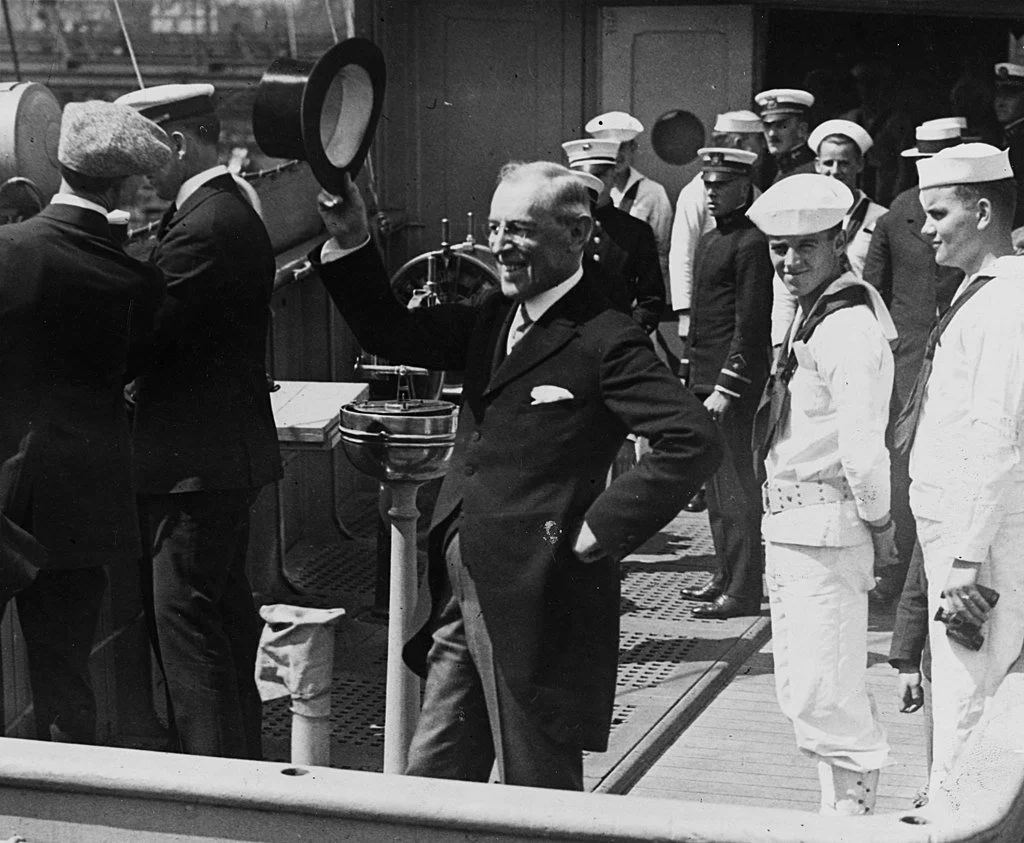
U.S. President Woodrow Wilson returning to America after the Versailles Peace Conference in July 1919.

American involvement in the First World War resulted from both the German Empire’s targeting of American ships via unrestricted submarine warfare and the sending of the Zimmermann telegram from Germany to Mexico. Wilson had the capability to claim that the U.S. was under threat from attack and did so, eventually contributing to the Western European war effort significantly and assisting in bringing the war to an end. From a strategic standpoint, Wilson’s overall stated goal was peace - he wanted the world to have the same ideals and beliefs that the United States itself had, or claimed to have. He repeatedly tried to broker a peace agreement between the warring factions.

I would argue that the most important result of U.S. intervention into the First World War was the retreat back into isolationism. Prior to WWI, the U.S. had been largely keeping to itself, largely engaging in domestic matters, and externally when the country was threatened (or perceived to be threatened) by a foreign nation within its sphere of influence. From the end of the Civil War to the First World War, the United States was becoming more involved in the global scene (with the taking of, what were essentially colonies, in the Philippines and Cuba in the Spanish-American War and multiple interventions in Mexico and Latin America). Despite this, the American public and political leaders retreated inward and left the global scene, instead focusing on “internal growth and development” by increasing tariffs, “that were enacted to restrict the influx of imported goods, thereby increasing domestic production”. While this was the initial motivation factor throughout the 1920s, the later collapse of the U.S. (and global) economy from 1929 further ingrained the idea that the U.S. should focus on domestic issues. The fact that congressional inquiries and anti-war books (USMC Gen. Smedley Butler’s War is a Racket among them) discussed wartime profiteering also put off many Americans on going to war for corporate desires.


Lack of commitment to the League of Nations

While these are certainly legitimate concerns for not going to war or becoming involved in the global stage, it is also possible that, had the U.S. been more committed to the League of Nations in the 1920s and 1930s, a stronger, global force may have been created that could have prevented Hitler’s rise to power, the rise of Fascism in Europe, and minimized the effect of the global economic depression of the 1930s.

David Carlin, a graduate of Williams College and a member of the United Nations Environment Programme Finance Initiative, wrote in an article on the Second World War that, “Poor Western leadership allowed the Nazi menace to grow to monstrous proportions. This catastrophic failure in leadership offers important lessons for decision-makers today… [in 1935] given the early stage of Germany’s military preparations, Western pressure could have easily neutralized the military threat. Failing to act when the stakes were low was the West’s first mistake.” Having a strong, global power like the League of Nations, with support from the largest and strongest nations in the world could have assisted in many problems that arose from the Treaty of Versailles and the ending of the First World War.

The First World War, while highly important, is not discussed or remembered enough in the United States today. I hardly recall learning anything substantial about the conflict in my high school and even some college history courses; for the most part, it was summed up as an international conflict in which the U.S. entered late and won the war.

Yet, the global conflict has had a long-lasting and important impact upon the U.S. in more ways than one. One of the biggest impacts in the United States was the fact that women were able to play much more of a role in society and this eventually helped to pave the way for voting rights. David Smith, a correspondent for The Guardian, has also said that, “The war was a catalyst for the great migration of African Americans, and those who returned from the war, finding inequality intact, demanded civil rights. In addition, the conflict heralded the rise of conscription, mass propaganda, the national security state and the FBI. It accelerated income tax and urbanisation and helped make America the pre-eminent economic and military power in the world”. Not only this, but medical advancements and improvements, such as, “…screening for tuberculosis, treatment for tetanus, vaccines for typhoid, prevention of venereal disease and disinfection for surgery” came about during and in the aftermath of the war.

Without doubt, many economic, social and cultural achievements and advancements came about from World War I. The First World War’s greatest and most long-lasting impact upon the world has been in the way the United States defines itself and the role the country should have in global politics and affairs.


The impacts

The United States has often desired not to focus on foreign matters, but to look inwardly at domestic issues. This struggle is illuminated very well by the aftermath of World War One, in which the U.S. kept out of the League of Nations and retreated to focus on the economy and social issues, more domestic issues. This is the most important and long lasting effect as the U.S. still, as a country, has not been able to decide its place in the world. The desire of the public to focus on internal issues (such as the 2008 banking crisis) instead of the U.S. intervention in the Middle East (combined with the unclear strategies, controversies around COIN (Counterinsurgency), and the problem of trying to fight global terrorist groups) is a more recent example of this. The 2016 Presidential election of Donald Trump, a blatantly isolationist figure, also shows how many Americans desire not to be involved in foreign matters and become a “strong, isolationist” power.

This, in my view, is why the way in which the U.S. conducts foreign policy measures and engages in the world around them is one of the largest and longest-lasting impacts of the First World War.


What do you think of the influence of World War One on America? Let us know below.

Even before the guns fell silent in 1918, historians have debated the “true” causes of the First World War. In attempting to point a blaming finger, these academics also reflected the times they lived in. So where does the historiographical debate on the origins of World War I stand now? Avan Fata explains. 

Depiction of Gavrilo Princip killing Archduke Francis Ferdinand of Austria in Sarajevo on June 28, 1914. An image from Domenica del Corriere, an Italian newspaper. Image by Achille Beltrame.

Depiction of Gavrilo Princip killing Archduke Francis Ferdinand of Austria in Sarajevo on June 28, 1914. An image from Domenica del Corriere, an Italian newspaper. Image by Achille Beltrame.

The narrative remains unchanged: on 28 June 1914, Archduke Franz Ferdinand, heir apparent to the Austro-Hungarian throne, was assassinated in Sarajevo alongside his wife Countess Sophie by Gavrilo Princip. Just a month later, the so-called “July Crisis” ended with Austria-Hungary’s declaration of war on Serbia. Yet what could have been a “Third Balkan War” instead escalated into a continental war, as the other great powers of Europe joined the conflict.[1] It is not uncommon for writers or documentary-makers to utilize cliché metaphors or dramatic phrases to underscore the sheer scale, brutality, and impact of the fighting between 1914-1918. Indeed, it is perhaps the event which laid the foundations for the conflicts, revolutions, and transformations which characterized the “short 20th century”, to borrow a phrase from Eric Hobsbawm.[2] It is no surprise then, that even before the Treaty of Versailles had been signed to formally end the war, people were asking a duo of questions which continues to generate debate to this day.


How did the war start? Why did it start?

Yet in attempting to answer those questions, postwar academics and politicians inevitably began to write with the mood of their times. In Weimar Germany for example, historians seeking to exonerate the previous German Empire for the blame that the Diktat von Versailles had supposedly attached to them were generously funded by the government and given unprecedented access to the archives; so long as their ‘findings’ showed that Germany was not to blame.[3] In attempting to answer how the war had started, these writers were all haunted by the question which their theses, source selection, and areas of focus directly implied: who started it? This article traces the evolution of those arguments and the contours of the debate around the events which began with a shooting in Sarajevo. 


Wartime Justification, Postwar Ponderance

The debate over the origins of the First World War began even while the war was being fought by the great powers. Governments of the great powers, in seeking to portray their involvement in the war as a just and noble act of self-defense, called upon historians to justify the country’s fighting as a just and moral decision.[4]

In some cases, this produced about-turns in the historical writings of entire academic communities. Herbert Fisher, a noted British historian who had praised Germany’s rise to power in the years before the war, changed his tone in a 1914 article titled The War, where he noted that: 

"Prussia has been made by the sword...That is one of the unalterable facts of history graven upon the mind of every German schoolboy, and shaping his whole outlook on the world.[5]"


These arguments were not debates in the traditional sense. How could they be? With the war still raging, historians were unable to engage in the international realm of discussion that had flourished in the prewar years. However, by the time the guns fell silent and the Treaty of Versailles had brought the war to an end, the opportunity arose for new debates on the origins of the War to End All Wars. 

During the interwar years, governments still sought to remove themselves of the blame of “starting” the war. They amassed multi-volume collections of thousands of archived materials (many of which had been previously classified), publishing them in the hopes that historians would find proof that their country had not been the one to engulf Europe in flames. Chief among these collections was the forty-volume Die Grosse Politik, published by the Weimar government, which contained documents dating from 1871-1914.[6]

These sources, previously inaccessible during the war, gave rise to new strains of historiography, which began to re-assess the "justifications" produced by each nation at the beginning of the war. In Britain, these collections of sources generated debates on the extent to which the German nation could be blamed for the First World War. This crusade's most prominent leader was George Peabody Gooch, a former Liberal M.P and author of distinguished historical works.[7] One of the first revisionists on the First World War, he argued alongside William Harbutt Dawson (another prominent historian on German), Raymond Beazely, and a few other British historians that the Germans were not the sole arbiters of war, and as such the peace treaty of Versailles was a flawed one.[8] Unsurprisingly, liberal parties in the Weimar Republic (and followers of a rising Nazi party) cheered the rise of these revisionist "Collective War Guilt" theses. German historians for their part, were re-mobilized to support and propagate these theses (with noticeably more nationalistic overtones). As historian Dennis Showalter describes:

"Strongly nationalistic and patriotic in orientation, matchless researchers and unrivaled polemics - controversy has long been an art form among German intellectuals - the pundits and professors rallied behind a cause lost by the soldiers. Given a previously unheard of access to government documents and frequently supported by government money, a generation of revisionists challenged and denied Germany's sole responsibility.[9]


An Unavoidable War? 

In the 1930s, these revisionist historians found a way to wash their nations conscience clean of the war. They pointed towards “larger forces”, the “mass demands” which had compelled the statesmen of 1914 to declare war. These forces, among them Social Darwinism, nationalism, and imperialism, provided the perfect solution. By assigning blame to these invisible movements and not a physical group or nation, the problem of “war guilt” could be swept neatly aside.[10]

Politicians also helped give rise to another historiographical norm during the 1930s, the idea of an “inadvertent war”. Simply put, they portrayed the decisions for war not as deliberate, measured choices made by well-informed statesmen, but as decisions made in the dark by leaders who were unaware of the consequences. Going further, several historians propagated the belief that the military had manipulated the civilian leaders into declaring war, or, as George Quester puts it: “at the decisive moment the military took over the direction of affairs and imposed their law.”[11]


Fischer, Taylor, and Historiography during the Cold War

As the Second World War gave way to the Cold War, First World War historiography was revived. Fritz Fischer is the name most associated with this revival, in part due to his namesake "Fischer Thesis", which argued that Germany was, as the first non-German historians had argued during the war, the responsible nation. This of course went against the previously accepted idea that the war had been the collective fault of the governments at the time, and Fischer's book Griff Nach der Weltmacht (Germany's War Aims in the First World War) was hotly debated by other European and American historians alike.[12]

In an era of antiwar sentiments, the First World War was now viewed as something of a pointless conflict, with many in the public pointing towards the interwar instability and Second World War as proof of how hollow the soldiers’ sacrifice had been a half century earlier.[13] With this prevailing mood, the “inadvertent war” theses found greater popularity. A notable work in this regard is A.J.P Taylor’s “War by Timetable”, which proposed that the Great War had been inevitable, accelerated greatly by the meticulous and inflexible mobilization plans that Europe’s powers had developed by 1914.[14]

Beyond the academic debate, the Cold War also influenced popular-history works on the July Crisis. Chief among them is Barbara Tuchman’s The Guns of August, which not only agreed with the “inadvertent war” theses, but portrayed Germany as a “barbaric” and warmongering European power whose armies marched “like predatory ants” across Belgium.[15] To a Western public that was locked in a geopolitical standoff with the monolithic empire of the Soviet Union, such rhetoric may have resonated well.


Current Historiography

In the 1990s, the debate over the origins of World War I began to shift towards what it is in the 21st century. With the Cold War having ended, historians were able to adopt a more disinterested yet critical view of 1914, and the resulting journal articles and theses made several things clear: 

1.     The “larger forces” which had once borne the responsibility of starting the conflict were dismissed. The war was a result of deliberate decisions made by government officials who had a good understanding of what they were getting into. Whilst the “mass demands” may have influenced their mentalities, they did not “force” war as previous historians had argued. 

2.     The military staffs, far from “taking control” of the decision-making bodies, continued to operate within their official capacities. At no point in any of the to-be belligerents did the military concerns override the diplomatic ones that the civilian statesmen possessed.

3.     The diplomatic mentality of the statesmen had been influenced, to varying degrees, by previous diplomatic crises of the 20th century, and investigating why these precedents failed in 1914 is thus a key focus.


Further, as a result of the distance from the First World War, historians in the 1990s emphasized a multinational approach to the matter. No country operated in isolation, and its diplomatic decisions in the lead up to war were influenced by the decisions that the other parties had made. As such, the common trope of assigning “war guilt” is noticeably absent in writings from the 1990s, replaced instead with critical analyses of why and how 1914 differed from a decision-making standpoint in each of the halls of power. 

Thus, there we have a general overview of how the focuses of historiography on the First World War have shifted in the past century, and it would perhaps not be too far-fetched to suggest that these focuses may very well change within the next century too. The next part shall deal with how the current historiography approaches the July Crisis in both its practices and focuses. 


What do you think of World War One historiography? Let us know below.


[1] The other “great powers” in question are Russia, Germany, Britain, and France; joined by the United States in 1917. Other “lesser” powers, whose contributions were still considerable, later included the Ottoman Empire, Bulgaria, Romania, Italy, and Japan. This classification taken from Richard F. Hamilton and Holger H. Herwig (eds.), The Origins of World War I (Cambridge: Cambridge University Press, 2003), 46-50.

[2] The term was first utilized in Eric Hobsbawm, The Age of Extremes: The Short Twentieth Century (London: Abacus).

[3] Margaret MacMillan, The War That Ended Peace: How Europe Abandoned Peace for the First World War (London: Profile Books, 2014), xxix.

[4] Dennis Showalter, “The Great War and its Historiography.” The Historian 68, no. 4 (2006): 713-715

[5] Quoted in Steven W. Siak. “’The Blood That Is in Our Veins Comes from German Ancestors’: British Historians and the Coming of the First World War.” Albion: A Quarterly Journal Concerned with British Studies 30, no. 2 (1998): 226-7

[6] Another noteworthy synthesis of such source materials is Luigi Alberini’s three-volume The Origins of the War of 1914 (1942 – 1943), which for a time remained the work to consult on the matter.

[7] Heather Jones, “As the Centenary Approaches: The Regeneration of First World War Historiography.” The Historical Journal 56 no. 3 (2013): 860-863

[8] Catherine Ann Cline, “British Historians and the Treaty of Versailles.” Albion: A Quarterly Journal Concerned with British Studies 20, no. 1 (1988): 46-50

[9] Showalter, “The Great War and Its Historiography.”, 716.

[10] Hamilton and Herwig, The Origins of World War I, 25-33.

[11] Quoted in Hamilton and Herwig, The Origins of World War I, 450.

[12] Frederick A. Hale, “Fritz Fischer and the Historiography of World War One.” The History Teacher 9, no. 2 (1976): 258-260.

[13] Alan Kramer, “Recent Historiography of the First World War (Part I),” Journal of Modern European History / Zeitschrift Für Moderne Europäische Geschichte / Revue D'histoire Européenne Contemporaine 12, no. 2 (2014): 160-161.

[14] Frederick Hale, ”Fritz Fischer and the Historiography of World War One,” The History Teacher 9, no. 2 (1976): 262-267.

[15] These quotations and poor view of the work are taken from Ulrich Trumpener, “The Guns of August by Barbara W. Tuchman,” The Journal of Modern History 35, no. 1 (Mar. 1963): 94-95. 

References

Cline, Catherine Ann. “British Historians and the Treaty of Versailles.” Albion: A Quarterly                           Journal Concerned with British Studies 20, no. 1 (1988): 46-50.                                                                                   https://www.jstor.org/stable/4049797.

Hale, Frederick A. "Fritz Fischer and the Historiography of World War One." The History                 Teacher 9, no. 2 (1976): 258-79.  https://www.jstor.org/stable/492292

Herwig, Holger H., and Hamilton, Richard F., eds. The Origins of World War I. Cambridge:             Cambridge University Press, 2003.

Jones, Heather. "As The Centenary Approaches: The Regeneration of First World War                   Historiography." The Historical Journal 56, no. 3 (2013): 857-                  78.http://www.jstor.org/stable/24529097.

Kramer, Alan. "Recent Historiography of the First World War (Part I)." Journal of Modern             European History / Zeitschrift Für Moderne Europäische Geschichte / Revue D'histoire   Européenne Contemporaine 12, no. 1 (2014): 5-                28. https://www.jstor.org/stable/26266110.

MacMillan, Margaret. The War That Ended Peace: How Europe Abandoned Peace for the                First World War. London: Profile Books Ltd., 2014.

Showalter, Dennis. "The Great War and Its Historiography." The Historian 68, no. 4 (2006):        713-21. http://www.jstor.org/stable/24453743.

Steven W. Siak. ""The Blood That Is in Our Veins Comes from German Ancestors": British              Historians and the Coming of the First World War." Albion: A Quarterly Journal                                Concerned with British Studies 30, no. 2 (1998): 221-52.                 https://www.jstor.org/stable/4053522.

Trumpener, Ulrich. “The Guns of August by Barbara W. Tuchman.” The Journal of Modern History 35, no. 1 (1963): 94-95.https://doi.org/10.1086/243637.

Germany is often blamed for causing World War I – and the 1919 Treaty of Versailles led to the country needing to pay large reparations to the winners. Here, Denise Tubbs continues her look at why Germany got much of the blame for World War I. She considers how the war ended, how Germany got the blame for the war, and the lasting impact in Germany.

Part 1 in the series is on the decades leading up to World War One is here, part 2 on the role of Austria-Hungary in the outbreak of war here, and part 3 on the roles of the Great European Powers in the build-up to war here.

The Signing of Peace in the Hall of Mirrors, Versailles 1919.

The Signing of Peace in the Hall of Mirrors, Versailles 1919.

Welcome back! We’ve covered a good deal of information during he first three parts of just how the world spiraled into chaos in 1914. But now the answer to the question that brought us here. Why did Germany get the blame? After all, the conflict would not have occurred without the assassination of Franz Ferdinand. He wasn’t even German, but Austrian. And what about those Austrians? Shouldn’t they carry some of this blame? They were the ones who wanted to fight in the first place. Germany had no direct reason to be involved other than having a treaty of military aid to Austria. 

So besides all that, let’s start with the most obvious reason: They were the first to invade anyone. Up until they crossed into Belgium in August 1914, no one had fired a shot, and no one had really believed that hostilities were that far gone. Things could have cooled, especially with Great Britain, if Germany had only got out of its own way. Arrogance and their determination at being seen as a major player is what started the war.


The War’s Progress

As the war progressed its long four-year ordeal, Germany, along with the rest of the Central Powers (that also included the Ottoman Empire and Bulgaria, who need their story told all on its own), began to crumble under the weight of starving troops, starving populations, and radical ideals bubbling to the surface of their cities. In 1917, Germany sent for a secret weapon to knock one of the fronts off its back. They chose the Eastern Front because Russia was simmering with revolution. That weapon was Vladimir Lenin. They paid his passage to Russia, arriving from exile like a missing hero ready to take the lead. By the end of 1917, Germany has knocked Russia out of the war by using the cries of revolution to do it. 

In Austria, things were going bad to worse. In 1916, the old Emperor Franz Josef died. His successor was the great nephew of the Emperor’s brother. Charles I, also known as Karl IV (in Hungary), became the ruler of the country at a time when change was a dangerous game. He would only be emperor for two years before abdicating his powers and abolishing the monarchy. The young King himself would be dead within 4 years of the war’s end. With the end of Austria-Hungary the land that made up the country was officially split. Austria became its own country and so did Hungary.


The Ottoman Empire

Of the other members of the Central Powers, the Ottoman Empire (known at the time as ‘the old man of Europe’ because they had been around since 1453) also came to a close. The sultan was deposed, although he had been nothing but a figurehead for quite some time. In fact in 1918 the Ottomans were forced to give up after the armistice between Bulgaria and the Allies. Suddenly the Ottomans had no help from them, Austria-Hungary had already begun to disintegrate, and Germany no longer had the manpower to send relief.  The Ottoman Empire signed its own armistice with Great Britain in October of 1918, just one month before the official end to the war.

In its peace terms, the Ottoman Empire was to be occupied by French, Italian, and British troops. It also stipulated that the Ottoman Empire be carved up into smaller countries; effectively ending the country as a whole. The area known as the Ottoman Empire became separate countries; including Turkey, Jordan, Iraq, Syria, Lebanon, Saudi Arabia, the boundary lines of Palestine, and the preliminary decisions of establishing land for a Jewish state. Turkey would end up changing their capital’s name from Constantinople to Istanbul.

Meanwhile, still in a position of power, the generals of Germany were beginning to see the unrest in their troops. Before long it becomes apparent that they had lost all control of their armies, and the rise of democracy became the voice of the people. While trying to salvage some remnant of the country, Kaiser Wilhelm was forced to abdicate the throne. But, unlike Austria-Hungary and the Ottoman Empire, Germany did not cease to exist. The country remained unified but was now a democracy. Their elective body became known as the Weimar Republic, had control over the country and helped negotiate the ending of the war. This is why Germany is blamed. Solely for the reason of ‘last country standing.’ The season of revolution arrived and in its ruins only Germany, for the most part, remained intact. I believe had any one of the other belligerents, Austria-Hungary or the Ottoman Empire been left with some power, the blame would have been split. Since neither country existed anymore, combined with the desire to teach Germany a lesson, is how this blame came to pass. 


Accepting Terms

On a train near one of the battlefields, the representatives of the new Germany Republic were forced to sign the official Armistice. Later on at the official signing of the Treaty of Versailles they were given no chance to negotiate the terms of the treaty. All the decisions were made by the victors, including a rather smug France who implored the peace talks be decided in Paris to begin with. This brought rise to the belief that those who signed for Germany were no more than traitors to their country. Hitler used parts of this to imply that Jewish politicians were to blame for surrendering so easily.

The terms of the treaty were as follows: German land was handed over to other countries. France acquired the Rhineland, and additional lands were split between Denmark, Belgium, and Czechoslovakia. The bulk of the land was given to the newly formed country of Poland; and any colonies that Germany had were also divided up amongst the allies. From a military perspective the treaty stipulated that the army be reduced to 100,000 men, and all remaining tanks were to be destroyed. The Air Force was dismantled and any German U-Boats were to be destroyed. Essentially the country was gutted and stripped of everything that made them proud.

The final terms of the treaty were the worst of all. Germany was ordered to repay the war debt that had accumulated over the course of the war. They were charged 132 Billion Gold Marks, with a requirement of 50 Billion to be paid in full. If we adjusted for inflation, that would be $393.6 billion dollars (using the year 2005 as a point of reference). This threw the country into shambles. The citizens had lost all faith and credibility in the Monarchy and the military. While the war started with the Kaiser playing an active role in the planning and decision making, by its end he had been completely in the dark as to what was actually happening in his own country. The two generals who essentially ran the country during this time were Erich Ludendorff and Paul von Hindenberg. Of these two, you could argue that Ludendorff was more responsible for decisions with a warped sense of reality to the loyalty of the German people and their troops.


Germany Post-war

With the Weimar Republic formed, Germany began elections under a new democracy and the former Kaiser went into exile. He ended up living the rest of his life in the Netherlands. He always thought that one day he’d return to his post but it never came. He sadly had hopes that with Hitler’s rise, he would return to prominence. But like so many others, he too was placed under Nazi Occupation in the last years of his life. 

The new government began paying the war debt immediately. Then when Hitler rose to power in the 1930s he ordered the debt not to be paid. The country would not begin to pay that debt again until after WW2. The total war debt would not be paid in full until the year 2010, some 92 years since its enforcement.


So what are your thoughts? Does Germany deserve the blame? Or is the perception of their guilt clouded by revisionist history? It’s a debate that will probably go on forever. The only thing we can all agree with is that the end of the war in 1918 was not a real peace treaty; it was merely an agreement to stop fighting - placing a band-aid on the sore spot to be dealt with at another time. Do you think if those who signed the armistice of 1918 would have done something different, if they knew what was to come within 20 years? We’ll never know.


Let us know your thoughts below.


Sources

Wikipedia 

Dan Carlin’s Hardcore History Podcast (Blueprint for Armageddon parts 1-6)

The History of the Great War Podcast

A World Undone: The Story of the Great War by G.J. Meyer

Posted
AuthorGeorge Levrier-Jones

World War I was a stage for many battles, big and small. Often overlooked or overshadowed by the more famous battles taught in the classroom, the fighting on the Italian Front proved to be very important for Italy’s reputation as a country and its inhabitants. It led to a significant loss of life, the absorption and reclamation of new territories, domestic unrest, and new alliances… for a while.   Georgie Broad introduces World War One's Italian Front.

Italian Alpini troops in 1915. From the Bibliotheque Nationale de France.

Italian Alpini troops in 1915. From the Bibliotheque Nationale de France.

Italy enters the war… But only just

In the years leading up to World War One, Italy had been allied with Germany and Austria-Hungary, a group more commonly and widely known as the “Triple Alliance”. Italy and Austria-Hungary had canonically be considered foes since 1832, and this tension showed in the August of 1914 when the Italian Government refused to enter the war alongside Austria-Hungary, and politicians began to consider the advantages of backing the Allies.

Many at the time, citizens and people in power alike, believed that Italy’s entering into the war at all was a bad move for the country. Even so, Italy as an entity was a relatively new nation state, becoming a unified country only after the
Risorgimento in the nineteenth century, and as a result, it was eager to establish itself on the European political scene as a force to be reckoned with. This ambition was all very well and good, though compared to other European powers (especially the countries Italy would be fighting should it enter the war), Italy lacked major industry. Most of its economy remained agriculturally based. But most importantly, it lacked a competent military. Such was the indecision that two groups formed – the “neutralisti” (who wanted to stay out of the war and who formed a majority), and the “interventisti” (who wanted Italy to enter the war). After much debate, those who wanted to enter won the debate, helped by the backing of Prime Minister Antonio Salandra and Foreign Minister Sidney Sonnino. With the promise of territorial expansion and resources from Britain, on May 3, 1915, Italy ceased to be a part of the Triple Alliance, and 20 days later declared war on Austria-Germany.


Early battles on the Italian Front

Fighting along the Italian Front was comprised of several battles, many of which took place in the Isonzo region. As was widely suspected, the Italian Army proved to be militarily inexperienced, leading to Italian officers overcompensating for their lack of military prowess with risky and overly aggressive tactics. Despite the fact that the Austrians were heavily outnumbered, the early battles in the Isonzo region lasted over two years and caused a significant loss of Italian life. As unequal as the number of troops was, the armies eventually reached a stalemate and the battles bogged down to the most base trench warfare.


Meanwhile, on the home front….

This turn of events made the controversial Italian involvement in the war even more unpopular, causing the already angry neutralisti to start saying “I told you so”. This attitude started to spread to the wider Italian population from Pope Benedict XV to the poorer citizens living in the small, far flung foothills of the country. While disapproval from the Pope was damning enough, it was in fact the unrest among the average citizen that caused more problems for the Italian war effort. Rumors of the lack of progress and high death rate began to spread around Italy, fuelling opposition in the population. It also led to the refusal of some to enlist and the rejection of conscription. Meanwhile, desertion in the army itself reached its highest ever level.

Such a high level of opposition eventually forced the awkward resignation of Italy’s Prime Minister and former avid supporter of Italy’s entry into the war, Antonio Salandra. Salandra was replaced by the ageing Paolo Boselli, which turned out to be a rather bittersweet progression. Boselli was the political equivalent of beige paint; he possessed no immediately obvious initiative, charisma, or talent – but he was a safe bet. He was not exactly the morale boost Italy needed, but any leader was better than no leader at all.


Later battles and victory

After the early battles that took place in the Isonzo region led to a stalemate, Italy’s bullish officers got tired of waiting and launched a counteroffensive in 1916, known as the Asiago Offensive. Alas for the Italians, this offensive resulted in no real gains.

However, the situation did improve with time. Later in 1916, fighting continued in the Isonzo and eventually the Italians captured the town of Gorizia. This was exactly the shot of morale that the Italian Army so desperately needed. From then on, victory for the Italians seemed a more realistic prospect, and in 1918, two vital battles occurred that secured the Italians victory for good. The Battle of the Piave River left Austrian troops in dire need of supplies and Italian troops in grave need of reinforcements (which eventually came from Britain, France, and the USA). After Italy received reinforcements, Armando Diaz – an Italian general - launched an offensive over the River Piave on Vittorio Veneto. This attack crushed the Austrian defensive line, resulting in an eventual truce flag being sent to Italian commanders on November 3, 1918, along with Austrian requests for peace terms. It was accepted, and fighting along the Italian front ceased.


Did you find this article interesting? If so, tell the world. Tweet about it, share it, or like it by clicking on one of the buttons below!

The Christmas Truce is one of the few positive events of World War One that is still widely remembered today. Here, Rebecca Fachner explains what happened during Christmas 1914, and how soldiers on different sides in the war showed their common humanity.

Normal
0


false
false
false

EN-US
JA
X-NONE


 <w:LatentStyles DefLockedState="false" DefUnhideWhenUsed="true"
DefSemiHidden="true" DefQFormat="false" DefPriority="99"
LatentStyleCount="276">…

Frohe Weihnachten und glückliches Neujahr (Merry Christmas and a Happy New Year in German). From a festive World War One card.

The Christmas season is now upon us, and with it, the true story of a true Christmas miracle, the Christmas truce in 1914 in the midst of World War One. 

The beginnings of World War I have already appeared in this space, and by December 1914, Europe was 5 months into the most brutal warfare that anyone could remember. It seemed that humans lost control and that the world had been turned upside down. Everyone was now realizing that they were in for a long war. Gone were the predictions of a 90-day war, of easy victory, heroism and bravado. As December began, troops on all sides grasped that boasts of “home for Christmas” were not going to be anywhere close to a reality.  All sides were beginning to understand that they were enmeshed in a protracted battle, and that it wasn’t going to remotely resemble their pre-war dreams of glorious battles for king and country.  This conflict had been and would continue to be brutal, degrading and all but unbearable.

By December troops were dug in along the Western Front in trenches that stretched for miles, staring down the enemy in their own trenches. In between was a no mans land of barbed wire and dead bodies. Trenches were typically between 90 and 275 meters (100 to 300 yards) apart, so the enemy was very much within visual range. The week before Christmas British and German troops began to exchange season’s greetings, and sang Christmas carols together. In some places, troops began to actually go into no mans land to give gifts of food, cigarettes and souvenirs. On Christmas Eve and Christmas Day, many troops ventured out of their trenches to greet their enemies, converse and enjoy holiday cheer.  Some used this as an opportunity to recover bodies that had been left in no mans land, and there were reports of several joint burials.  In many places, however, the celebration was much more lively, and shared meals were reported, as well as several soccer (or football in British English) games.  Most of the football games were comprised only of allies, but here and there along the front, enemies came together to organize football games together.

British and German troops together during the 1914 Christmas Truce. December 26, 1914.

British and German troops together during the 1914 Christmas Truce. December 26, 1914.

 Different truces

The name for it, the Christmas Truce, implies some sort of official truce or formal recognition of the events, but in fact there was really nothing of the sort.  These truces were in no way official, nor were they encouraged or even sanctioned by the command structure of either side. Rather they were spontaneous demonstrations of Christmas cheer from troops who had a desire to put down their weapons and celebrate with their enemies.  The truce did not encompass the entire Western Front, it was much more individual and grassroots led.  Some units did not observe a truce at all; in fact, in some places there was fighting over the Christmas period.  In some areas the Truce was little more than a completely informal ceasefire for the day, nothing formal, just an observance of the holiday.  Others used the opportunity to collect their unburied dead.

It must be said that the Truce was mainly between the British and the Germans on the Western Front.  The French did participate, but to a much lesser degree, possibly because the Germans had actually invaded their country. There was even a Christmas Truce in the East, which looked very different when compared to that in the West. In the East, Christmas celebrations were complicated by the fact that the Russian Orthodox Christmas is celebrated later, in early January. The truce in the East was more formal, too, with the impetus coming from somewhere in the Austrian military hierarchy.  The Austrians had the idea for a ceasefire, and the Russians responded positively, and so the Austrian army was ordered not to fire unless provoked on Christmas.  One unit in Galicia even brought a Christmas tree into no mans land, and in several places the two sides met to exchange gifts of schnapps and food. A few days later, when the Russian troops celebrated Orthodox Christmas, Austrian troops held their fire to allow the Russians to celebrate.


Christmas 1915

The Christmas Truce was not received as well by the military hierarchy on the Western Front. Both sides independently agreed that the Truce had been an inexcusable breach of military discipline, and a frightening opportunity for significant fraternization with the enemy. Military command was worried that the Truce was a tacit renunciation of the war and of non-cooperation by the enlisted, while it gave troops the opportunity to humanize their enemy. For this reason, Christmas 1915 looked very different, with many commanders forbidding fraternization, and some even ordering raids and artillery bombardments specifically for Christmas. There were very small-scale attempts at a truce in 1915 and later, but they were largely unsuccessful. 

The Christmas Truce of 1914, 100 years ago this Christmas, is a wonderful example of the human spirit triumphing over the brutality of war. It provides an all too rare glimpse into the human side of World War One, something apart from the killing and suffering.


Did you enjoy this article? If so, tell the world! Tweet about it, like it, or share it by clicking on one of the buttons below!

Now, you can read Rebecca’s article on how World War One’s Eastern Front differed from the Western Front here.

In spite of the fact that they were constructed centuries before the start of World War One, Medieval castles had a role to play in that war. The grand old structures were useful defensive locations and could be used to attack the enemy. Here, Rowena Hartley tells us the story of two castles in southern England and how they were used in World War One.


The First World War saw a great change in British society as the population, economy and industry were mobilized more than ever before. Yet it was not only the modern parts of society that were affected. Like many countries in Europe, Britain is dotted with the remains of old castles and forts that had been specifically made for defending and housing the troops from as early as the Middle Ages. With the threat of invasion from Germany, these old castles once again came into use as a place to house troops and mount defensive operations. 

St Mawes by&nbsp;J.M.W. Turner, circa 1823.

St Mawes by J.M.W. Turner, circa 1823.

The south coast of England was naturally viewed as the most vulnerable to invasion as it lay closest to France. Therefore the southern ports and estuaries had to be defended against potential attacks. If they had fallen this would have given the Germans a safe place to harbor their ships; and in the case of an estuary, a river that could lead them to cities and strongholds further inland. Given the history of Britain, many of these ports have been the sites of vicious battles in the past and so were tactically significant for the same reasons they were in WW1.

The castles of Pendennis and St Mawes lay either side of the River Fal in Cornwall, South West England. Together they are a perfect example of how castles were repurposed from the medieval era to suit the purposes of modern warfare.

A twentieth century gun in front of the Tudor Pendennis Castle. Author's image used with author's permission.

A twentieth century gun in front of the Tudor Pendennis Castle. Author's image used with author's permission.

Pendennis and St Mawes under the Tudor Kings

In the mid-16th century England was faced with the threat of invasion from continental Europe, although in that time it was from the Catholic countries of France and Spain. The Protestant king, Henry VIII, needed to have military buildings which could match his taste in powerful enemies; this led to an explosion in military spending and castle building especially along the south coast.

Pendennis and St Mawes were built from 1539 to 1545 with a central fort and gun tower to hold the cannons and a small garrison of soldiers. These types of castle were known as Device forts or Henrician castles; this meant they were comparable to the machine gun nests of trench warfare -good for killing at a distance but not easy to defend at close quarters. The cannons housed in Pendennis and St Mawes were capable of shooting half way across the River Fal so access to the estuary was near impossible without a ship incurring serious damage, especially as St Mawes was built in a clover-leaf pattern so that it could target as much of the estuary as possible. Yet the castles were vulnerable to an attack from the land, especially when compared to vast fortresses and towns of Europe that could survive sieges of months (such as Boulogne in France which withstood Henry VIII’s attack from July to September 1544).

Throughout the Medieval era there were various advances in castle building and naturally each country attempted to keep up with such advances. The greatest advancement of the 16th century was the creation of Trace Italienne, also known rather less impressively as star castles.  As the name suggests these castles were built without the straight squares or rounded curves of previous designs but rather with triangular walls that jut out from each other meaning that there were no blind spots for the guns as each triangle of the star could be seen and shot at from another of the triangles. In siege warfare this meant that the enemy could not use battering rams on any part of the castle without being victim to near constant attack.

After the death of King Henry VIII his Protestant successors, Edward VI and Elizabeth I, also suffered from the paranoia that the country would be invaded by the powerful Catholic countries. This meant that they began to adapt Henry’s castles to accommodate these architectural advancements. The cloverleaf design of St Mawes meant that it was already relatively well equipped for such warfare but Pendennis’ close central fortress was relatively vulnerable. So at the end of the 16th century Pendennis was redesigned to accommodate the technological advances. The central fortress largely remained unchanged in design but a new outer wall was added in the distinct star castle shape and a moat was dug with the excess earth being used to add height and padding to the outer fortifications. The castle was now able to defend the River Fal as well as survive an attack from the land.

The later Pendents buildings, where World War One and Two soldiers' barracks were located, taken from the castle barracks. Author's image used with author's permission.

The later Pendents buildings, where World War One and Two soldiers' barracks were located, taken from the castle barracks. Author's image used with author's permission.

Testing the Fortifications

However, unlike the castles of Europe (especially Italy where the Trace Italienne originated), English castles were rarely fell victim to sieges. It was only truly Elizabeth’s vastly expensive fortifications at Berwick-Upon-Tweed that defended the border between England and Scotland that actually tested the star castles on British soil. Although Elizabeth’s successor effectively united England and Scotland leaving this vast castle practically pointless other than as a testament to the expensive military tastes of the Tudors.

Therefore it was not until the English Civil War of 1642 to 1651 that Pendennis and St Mawes were tested, as they were Royalist strongholds supporting King Charles I against the republican Oliver Cromwell. The more recently developed Pendennis castle survived a 3-month siege and only surrendered when the men ran out of food. However, St Mawes failed to play to the castle’s strengths; instead the commander, believing that the republicans would attack by sea, aimed all of his guns towards the River Fal only to find Cromwell’s men knocking on his gates after a highly successful land attack. Despite their failure in the Civil War, no further changes were made to either castle, as they were believed equal to their role of defending their corner of the south coast.

From the 17th century to the early 20th century there were not too many serious threats of invasion, but Britain managed to successfully aggravate the majority of countries in Europe and beyond, which was enough cause to keep a small garrison to man both castles in case of invasion. No great changes were made to the outer fortifications but the insides of Pendennis castle were modernized in the Georgian era, especially as Falmouth, the port town at the foot of Pendennis castle, was benefiting from trade in the British Empire. St Mawes remained largely untouched and while Pendennis stands apart on a hill side the smaller sister castle is almost obscured by the residential buildings running up to its gates.


St Mawes Castle from the River Fal. Author's image used with author's permission.

St Mawes Castle from the River Fal. Author's image used with author's permission.

Improving and Rearming

Since the attack of the Spanish Armada in 1588, England had not faced too many serious threats of continental invasion and so, despite the events of the English Civil War, the castles of Pendennis and St Mawes had not been updated to deal with more modern weaponry. This changed with the outbreak of the First World War; although the Germans never landed on British soil the fear of naval attack was very great. Naturally new and purpose built defenses popped up in reaction to the First World War, such as trenches and “Pillboxes” (small camouflaged huts made of stone which provided a hidden shooting space). Yet, however newly built these defenses were, they were still basically lumps of stone and mud which were far less purpose built than the great defensive structures of the 16th century.

So why take the time to build new defenses when you live in a country dotted with well-fortified and highly serviceable castles in key tactical locations. Pendennis and St Mawes, as well as countless other castles across Britain and Europe had stood for hundreds of years and it is testament to the original architects and tacticians that very little was done to change them to suit the very modern First World War.

St Mawes saw no great structural changes. Machine guns and modern artillery weapons were installed and aimed across the River Fal to deal with any naval threat, and many of the old canons still remained in its grounds during the war. Deeper trenches were cut along the outside fortifications, although whether these followed previous patterns is unclear, and an old gunpowder store was then filled with the shells and bullets common to modern warfare. Across the river far greater changes were under way Pendennis was the command center for artillery defenses in West Cornwall and so needed up to date equipment in order to effectively defend the headland. Yet whilst some minor fortifications and underground bunkers were added little else was done to modernize the castle itself. Georgian buildings which stand across from the castle, but within the fortifications, housed soldiers who were being trained before leaving for the trenches of Belgium and France, but even here the buildings were only changed in minor details as this area had originally been built to house a garrison. Further small changes were made upon the outbreak of the Second World War, but after the modernization during World War One, little changed. The castle and barracks housed British and American soldiers who updated a few guns and installed equipment for identifying and firing upon submarines and enemy vessels.

There is a tendency to look upon the First and Second World Wars as revolutionizing warfare. After all, the advances in guns, machine guns and bombs were vast. Yet the centuries-old castles that dot the European countryside were still used to house garrisons and mount defenses. These castles were used to support soldiers as well as protect against gun and cannon fire, making them very useful defensive bases. I wouldn’t argue that they’d survive a modern nuclear attack but the bunkers would make them a far safer bet than nearby settlements. It appears that despite the increasing modernization of warfare, old rules still apply. The recent wars in the Middle East faced as much difficulty as the European empire builders centuries before, no one would invade America without expecting fierce grass roots resistance, and most people know not to attempt attacking Russia in winter. The trenches, tanks, planes and advanced artillery of the First World War may have changed the parameters of warfare but in many cases the scenery remained the same – and only slightly more camouflaged than the grand stone buildings of the medieval era.


Did you find the article interesting? If so, tell the world. Tweet about it, share it, or like it by clicking on one of the buttons below!

References

The Siege of Leningrad and the Battles for Moscow and Stalingrad in World War Two (WWII) are well documented, but very little, certainly in the West, has been written about the Eastern Front during World War One (WWI). Apart from the crushing blows to the Tsar’s Imperial Russian Army at Tannenberg, the Masurian Lakes and the German Army’s march east, the only other battle that ever seems to get a mention is the short lived Brusilov offensive in June 1916.

Here, the author Frank Pleszak returns to the site and tells us about the little known Battle of Vileyka in September 1915.


During WWI there was significant fighting and demonstrations all along the eastern front from Riga on the Baltic Sea in the north all the way south to Romania, and once Romania entered the war, right down to the Black Sea. My dad was born and raised in a small Polish village about 100 kilometres east of Vilnius near to Lake Naroch (in what is now Belarus). Though he never mentioned it, there was a huge, and to the Russians catastrophic, battle there in the spring of 1916. It was of such importance that the historian Norman Stone said of it “Lake Naroch was, despite appearances, one of the decisive battles of the First World War. It condemned most of the Russian army to passivity”.

The ‘Battle of Lake Naroch’, the ‘Russian Spring Offensive of 1916’, occurred following the Russian ‘Great Retreat’ when the Eastern Front had settled down into positional trench warfare. It was an ill conceived, poorly planned, and disastrously executed Russian offensive across a front of nearly 100km over a series of frozen lakes and swamplands. Its intention was to bring Vilnius into striking distance in an attempt to draw German troops east and away from their offensive on the Western Front at Verdun. The Russian 2nd Army massively outnumbered the Germany XXI Army Corps, almost 450,000 infantry to 75,000 but suffered staggering losses of more than 120,000 while the Germans lost about 20,000. After two weeks of bloody and futile fighting in the most appalling conditions the battle came to an end with the Russians having only captured a tiny area to the south of Lake Naroch.

Fighting at Ladischky-Bruch during the Battle of Lake Naroch.

Fighting at Ladischky-Bruch during the Battle of Lake Naroch.

Forgotten?

There is almost nothing written about this battle in the west and it is in danger of being lost to history. In a small effort to prevent this happening I have researched the battle from both sides and almost completed a book on the subject that should be published later this year.

Other than the Brusilov campaigns, Russia did have some other battlefield success. In fact in the lead up to the Naroch debacle, the battle for the small town of Vileyka, where the German advance east was stopped and then pushed back is considered by some to be one of the most significant military victories ever achieved on Belarusian soil. There will be a chapter with detailed information in my forthcoming book, but I include a summary here…


So, following on from the success at the second battle at the Masurian lakes at the end of February 1915, the German X Army, commanded by General von Eichhorn, after heavy fighting, had by mid-August, taken the strategically important fortress at Kaunas but then found the capture of the city of Vilnius altogether harder.

After regrouping to the north of Vilnius, supplemented with additional reinforcements, von Eichhorn’s X Army bypassed Vilnius and towards the end of August broke through Russian General Radkevich’s 10th Army in the so called Swenziany (Švenčionys) gap. Elements pressed on east through the city of Postavy towards Hlybokaje, but the bulk of the force headed south-east towards the City of Maladzyechna (Molodechno) and the primary objective; the city of Minsk.

By mid-September, amidst stiff opposition, General von Garnier’s VI Cavalry Corps (H.K.K.6.) had captured the towns of Vileyka and Smorgon. The 3 Cavalry Division moved on towards Maladzyechna, some units even approached the west of Minsk, and others had penetrated to the east of Minsk and attacked a bridge along the Beresina River south of Borisov. Stavka, the Russian high command, were clearly concerned. Not only was Maladzyechna an important railway cross roads but it also contained important secret government and military installations. 

German cavalry attack at Vileyka.

German cavalry attack at Vileyka.

On 17 September, as the German X Army began to surround Vilnius, Russian forces were withdrawn and the city ceded to the Germans. But as the German Army marched east their supply lines had increased and become severely stretched. Russia’s had shortened and their material losses were made good from increased production at home together with supplies from France and England. The Russian 2nd Army, devastated at Tannenberg and then obliterated at the Masurian Lakes, had re-formed and re-grouped, and under General Smirnov were given the ‘honour to finally halt the German advance’.


Back on the front foot

The H.K.K.6.’s rapid advance had left them vulnerable. Whilst they had easily crossed the rivers, streams and swamps their infantry and artillery support struggled over rivers with bridges blown up by the retreating Russians. The Russian 10th and 2nd Armies struck back, and immediately halted the German advance before Maladzyechna, and then pushed them back north along a 40km stretch of the River Wilja from the town of Vileyka to Milcza where they were slowly reinforced with advanced infantry units of the 115 Infantry and eventually 75 Reserve Divisions.

Extent of the German X Army Advance East.

Extent of the German X Army Advance East.

By 22 September the town of Smorgon between Vilnius and Maladzyechna had been recaptured by a combination of a Russian 10th Army offensive together with Russians withdrawing from Vilnius. The Germans were exhausted and hungry, most of their artillery and supplies of food and munitions were still far behind their front. The Russians counter-attacked at Vileyka. Smirnov’s 27th Army Corps commanded by General Balanin had moved into positions to the south of Vileyka along the southern bank of the River Wilja and bombarded German positions. At 16:00 an infantry company supported by a machine gun company attacked across the railway bridge south of the town, scattering the German defenders that enabled two companies to ford the river and through the night occupy high ground to the southwest of the town.

By the early morning of 23 September all the Russian artillery, including two heavy batteries, had assembled to the south of Vileyka and by the same time further infantry had crossed the Wilja near the village of Olszyna just to the east of Vileyka causing a distraction to the German defences. Taking advantage, a further three infantry brigades were moved quickly from reserve to consolidate the breakthrough.

Russian Artillery.

Russian Artillery.

The Germans regrouped and counter-attacked the positions to the south and west, but even more Russian Infantry was brought up to assist. The German action was brave but futile and by mid-afternoon as the Russians massed ready to storm Vileyka from the south, southwest and west of the town the Germans stubbornly repeated their attacks. At 16:00 massed Russian artillery began bombarding the outskirts of the town and at 16:30, as the wooden houses burned, Russian Infantry moved forward from the south. Within minutes they had driven the Germans back towards the centre of the town. Fierce hand-to-hand and bayonet fighting took place at almost every building but by 17:00 the centre was under total Russian control. Dogged German resistance prevailed around the cemetery and at the nearby prison but with the assistance of targeted Russian artillery the fighting quickly moved to the northern outskirts where a German howitzer was captured. The Germans fought desperately to recover the lost gun but Russian support arrived and repeated German attempts failed.

Russian Map of attack (original dates in Julian format).

Russian Map of attack (original dates in Julian format).

At the same time Russian units moved, largely unopposed, around the west of the town preventing any German withdrawal to the west. Fighting within Vileyka concentrated along the northern perimeter and particularly around the railway station where a furious firefight erupted with the station changing hands several times. More Russian units moved in from the southwest and eventually cleared the remaining resistance around the cemetery before moving to the northern edge of town where they helped capture the station.


The closing stages

20 kilometres to the east at the village of Sosenka Russian cavalry failed in an attempt to capture the bridge over the River Wilja that was guarded by a single company of 80 German defenders. But nearer to Vileyka Russian infantry had crossed the Wilja around the village of Kasuta and within 4 hours had forced the German X Army back along the road towards the town of Kurzeniec, capturing the villages of Kaczanki, Hrycuki, and Kłynie together with several light field guns in the process.

Further Russian infantry crossed the Wilja capturing the villages Chołopy and Małmhy on the eastern outskirts of Vileyka. The remaining Germans were surrounded on three sides and their support was too far back to assist. Their position was hopeless so during the night all remaining units were withdrawn to new positions north of Vileyka around the village of Wołkowszczyzna.

The battle for Vileyka was effectively over. The Germans, overstretched without supplies, exhausted and hungry, struggled on for a few more days but with increasing demands from the Western Front it became clear that the prospect of any further German short-term progress to the east was unrealistic. On 25 September General von Hindenburg ordered a halt to the advance east, withdrawal of all the forward troops along the River Wilja back to positions around Lake Naroch, and for the establishment of permanent defensive lines (Dauerstellung) which were developed through the winter of 1915.

Isolated but bloody fighting erupted periodically in sections along the whole of the new front through the winter and early spring of 1916. Both sides continued to build up their forces and prepare for battle, but neither were prepared for the onslaught that eventually came in the March of 1916. The Russian success at Vileyka was not to be repeated; in fact, despite overwhelmingly superior forces they were so badly beaten that the consequences were drastic and far reaching…


Frank Pleszak has written a book about his father’s journey from near Lake Naroch via the GULags of Siberia to England entitled Two Years in a Gulag.

It is available here: Amazon US | Amazon UK

You can also hear an excerpt from the book in our related podcast here.


Frank has also almost completed a book on the Battle of Lake Naroch. His YouTube presentation is here. He is working on a history of the Polish 2nd Corps – Anders Army. Finally, Frank’s Twitter handle is @PolishIICorps.